

Turning a continuous surface into defined boundaries is how maps become plans. For some time now you have been asking for percent-based contours directly from density rasters— without employing multiple other tools or external scripts and processes to calculate area based on percentiles. Introduced in ArcGIS Pro 3.6 release, the Value Percentile Contours and Volume Percentile Contours tools provide a one-step solution to what previously was a multi-step workflow. This blog walks you through the tools and some of its key capabilities, what each tool does, how to use them individually and together and how they flow into decisions.将连续表面转化为明确的边界,是地图转变为规划的过程。一段时间以来,您一直在要求直接从密度栅格获取基于百分比的等高线,而无需使用多个其他工具或外部脚本及流程来基于百分位数计算面积。在ArcGIS Pro 3.6版本中推出的值百分位等高线和体积百分位等高线工具,为以前的多步骤工作流提供了一步到位的解决方案。本博客将带您了解这些工具及其一些关键功能,每个工具的作用,如何单独和联合使用它们,以及它们如何助力决策。
Why use these tools? 为什么要使用这些工具?
Many of you across different domains– from public safety, public health to planning and ecology– often start with events or observations points data leading to a density or risk surface. The challenge is turning that surface into a defined area or boundary to answer the questions of which are the priority areas for investment or where are the hotspots that the policymakers can easily understand. Historically, extracting this information required a multi-step workflow, external scripts or manual data processing. Now you can create percent-based contours in just one step– right from the Density toolset in ArGIS Pro.你们中许多人来自不同领域——从公共安全、公共卫生到规划和生态学——通常都是从事件或观测点数据入手,进而得到密度或风险面。难点在于将该面转化为明确的区域或边界,以回答哪些是优先投资区域,或者哪些是政策制定者能轻松理解的热点区域这类问题。过去,提取这类信息需要多步骤的工作流程、外部脚本或手动数据处理。而现在,仅需一步,你就能在ArcGIS Pro的密度工具集中创建基于百分比的等高线。
What do the two tools help answer?这两个工具有助于回答什么问题?
The Percentile Contours tools answer two different but complementary questions about the same surface. Value Percentile Contours outline the footprint of the highest local intensities by area. Think of them as the map of where the extremes spread— the top end of the surface. You do not need to specify a numeric break; the tool finds the percentile threshold and returns polygons where values meet or exceed that cut.百分位等值线工具针对同一表面回答了两个不同但互补的问题。值百分位等值线勾勒出了按面积计算的最高局部强度的范围。可以将其视为极端值分布区域的地图——即表面的顶端部分。您无需指定数值断点;该工具会找到百分位阈值,并返回值达到或超过该阈值的多边形。
On the other hand, Volume Percentile Contours outline the smallest area that contains the specified share of the whole. They show where most of the phenomenon resides— a compact core for strategy. Behind the scenes, the tool ranks cells from high to low and accumulates volume (value × cell area, with Planar or Geodesic method available for area calculation) until the target share is reached, then draws the boundary at that threshold. To simply express, Value is the extent of highs and Volume is the core of the whole.另一方面,体积百分位等高线勾勒出了包含整体特定比例的最小区域。它们展示了该现象的主要分布位置——这是战略规划的一个紧凑核心。在后台,该工具将单元格从高到低排序,并累积体积(值×单元格面积,面积计算可采用平面法或测地线法),直到达到目标比例,然后在该阈值处绘制边界。简而言之,“值”代表高点的范围,而“体积”则代表整体的核心。
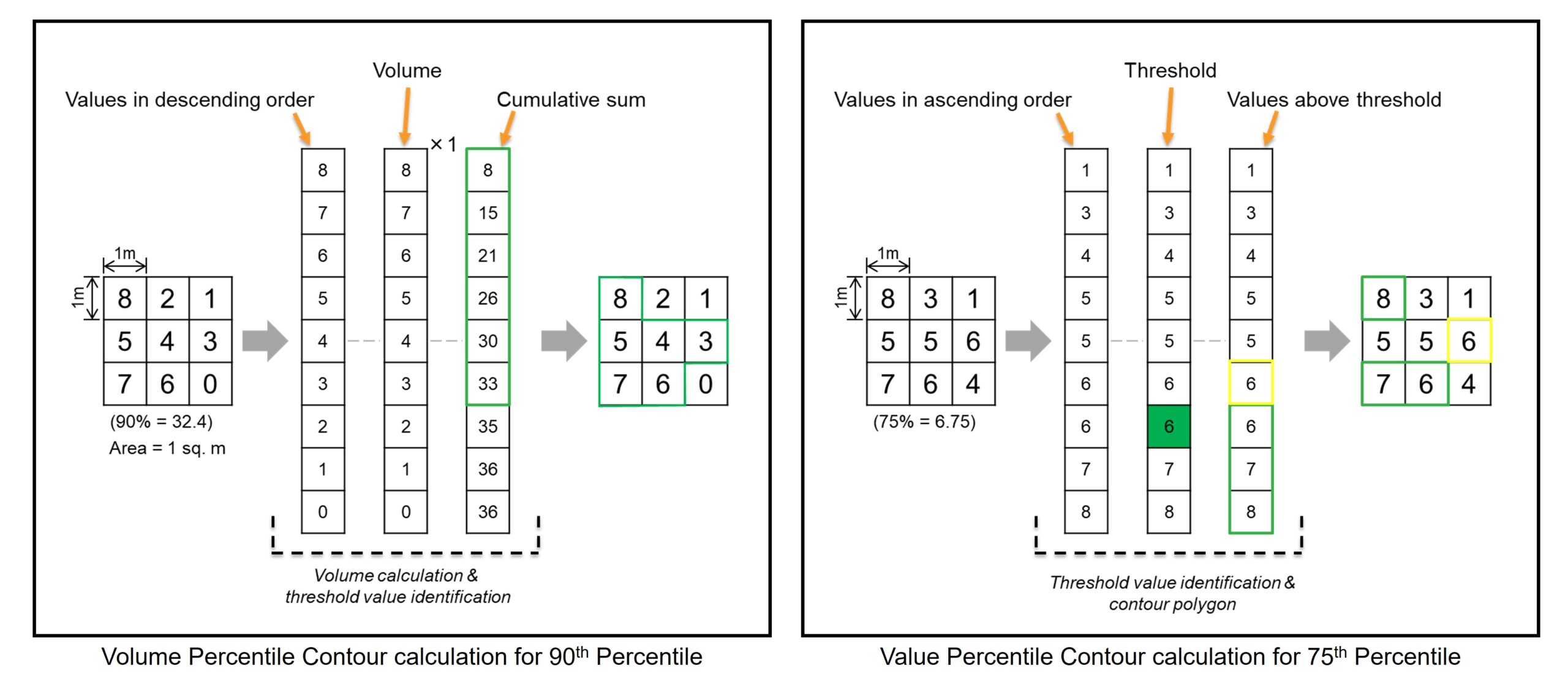
To learn more about these tools, how they work and the algorithms behind them, see How Value Percentile Contours works and How Volume Percentile Contours works.要了解更多关于这些工具、它们的工作原理以及背后的算法,请参阅价值百分位轮廓的工作原理和体积百分位轮廓的工作原理。
Why two separate tools and why use both?为什么需要两个独立的工具,又为什么要同时使用它们?
Using the percentile contours tools, we answer two different questions from one Density surface. Value is ideal for short-term initiatives. It’s sensitive to the sharp local highs that matter tonight or this week— perfect for directed patrols, inspections, or immediate mitigation. Volume is ideal for long-term strategy. It’s built from the accumulation of the whole surface and tends to be stable from month to month— perfect for staffing, lighting, Crime Prevention Through Environmental Design (CPTED) approaches, capital planning, or sustained outreach.通过百分位等高线工具,我们可以从一个密度表面回答两个不同的问题。“值”适用于短期举措。它对当下或本周重要的急剧局部高点很敏感,非常适合定向巡逻、检查或即时缓解措施。“量”适用于长期策略。它基于整个表面的累积数据构建,且每个月往往保持稳定,非常适合人员配置、照明、通过环境设计预防犯罪(CPTED)方法、资本规划或持续的外展工作。
Using both prevents blind spots: you see how hot a place is and how central it is to the overall burden. A cell can be very high (Value) yet peripheral to the total, or only moderately high but inside the core where most of the problem accumulates (Volume).同时使用两者可以避免盲点:你能看到一个地方有多热,以及它在整体负担中有多核心。一个单元格可能数值很高但在总量中处于边缘位置,或者数值只是中等偏高但位于问题主要累积的核心区域(即数量方面)。
Let’s see how these two tools can be used in a public safety application workflow.让我们看看这两个工具如何在公共安全应用工作流程中使用。
Example: from a density surface to strategy and tactics示例:从密度表面到战略与战术
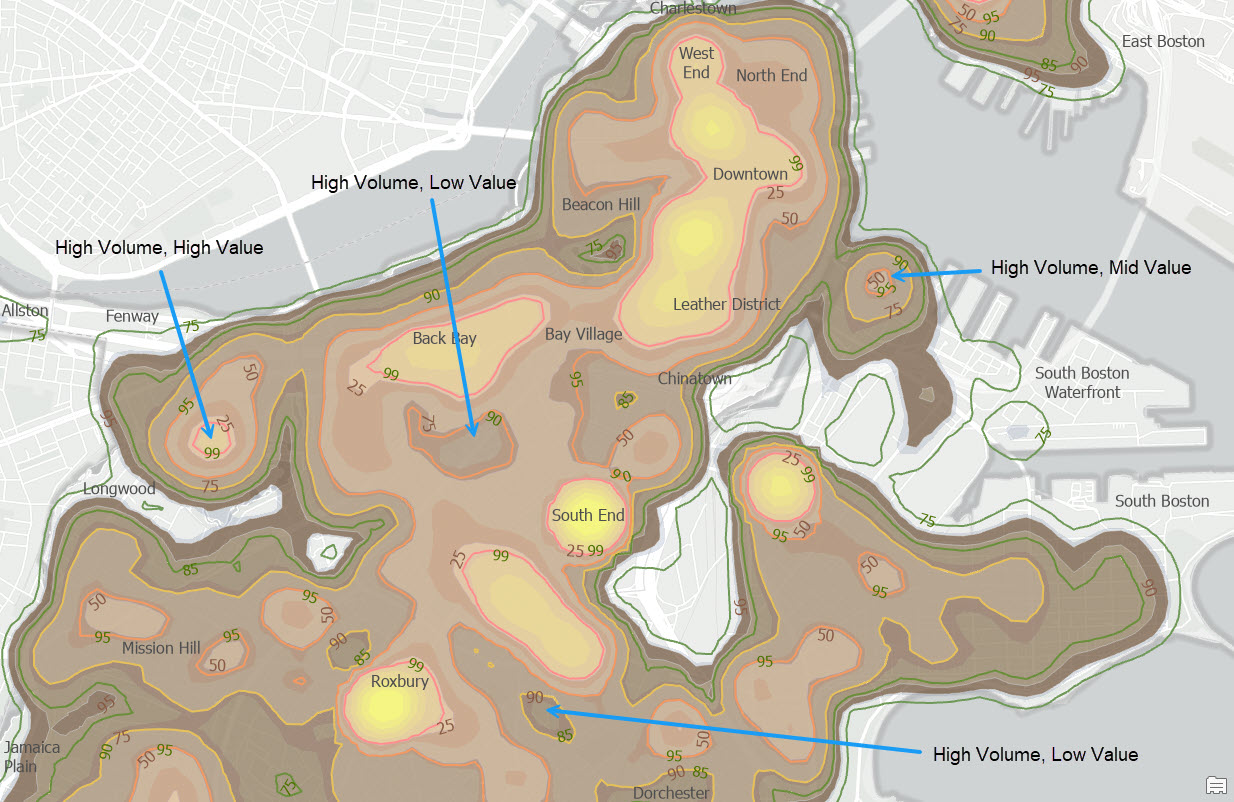
We’ve converted reported crime incidents (2015–2024) into a continuous surface using Kernel Density. First is to identify the strategic core with Volume Percentile Contour. For that we can use the 50th percentile values as the threshold. The tool ranks the highest cells first and accumulates until half of the overall amount is captured. The result is the smallest area holding half of the problem. This is where broad, sustained actions pay off without spreading thin.我们利用核密度将2015–2024年的已报犯罪事件转化为连续的面状数据。首先,通过体积百分位等值线确定战略核心区域。为此,我们可以将第50百分位值作为阈值。该工具会先对数值最高的单元格进行排序,然后不断累加,直至覆盖总量的一半。其结果是能容纳一半问题的最小区域。在这个区域,广泛且持续的行动能产生成效,而不会精力分散。

While the output is useful for long-term planning, what about the spots that need immediate attention? For that, we will use the Value Percentile Contours tool. With the same Density raster, now we will set the percentile value to 95%. The output value percentile contour shows all locations where the density is in the top 5% – places most likely to need immediate attention: patrols, site checks, quick fixes.虽然该输出对于长期规划很有用,但那些需要立即关注的地点该怎么办呢?为此,我们将使用价值百分位等高线工具。在相同的密度栅格下,现在我们会将百分位值设置为95%。输出的价值百分位等高线显示了所有密度处于前5%的位置——这些地方最有可能需要立即关注,比如巡逻、现场检查、快速修复等工作。

Now we can use outputs from both these tools and generate actionable intelligence. For example, if you see a place with Value 95 and Volume 25, that location is both very high and captured early in the accumulation—hot and central. In contrast, if you see Value 90 | Volume 75, it’s still high but more peripheral—better for monitoring and targeted follow-ups than heavy deployment.现在我们可以利用这两个工具的输出结果,生成可付诸行动的情报。例如,如果你看到某个地方的价值为95,数量为25,那么这个位置不仅价值很高,而且是在积累阶段早期被捕获的——既热门又处于核心位置。相比之下,如果你看到价值90 | 数量75,那么它虽然仍处于较高水平,但更偏向边缘——这种情况更适合进行监控和有针对性的跟进,而不是大规模部署。
When to use which tool? 何时使用何种工具?
Use Value Percentile when your question is about extent: “Where are the highest values occupying a given share of area?” Typical uses include top-end heat islands, noise exposure footprints, worst travel-time areas, or the upper tail of risk surfaces.当您的问题涉及到程度时,请使用“值百分位数”:“占据特定面积比例的最高值位于何处?”典型用途包括高端热岛、噪音暴露范围、最差旅行时间区域或风险表面的上尾部分。
Use Volume Percentile when your question is about amount: “What is the smallest area that holds a chosen share of the whole?” Typical uses include compact cores of expected storm losses, crime intensity, outbreak burden, or wildfire likelihood. You can also pair Volume and Value to delineate the core (with volume 90), envelope (with volume 50) and tactical spikes (with Value 95).当您的问题涉及到数量时,请使用体积百分位:“能容纳整体选定份额的最小区域是多少?”典型用途包括预期风暴损失、犯罪强度、疫情负担或野火可能性的密集核心区。您还可以将体积和价值结合起来,划定核心区(体积为90)、外围区(体积为50)和战术峰值区(价值为95)。
Way forward: Doing more with Density analysis前进方向:借助密度分析实现更多功能
Percentile contours are a natural next step after Kernel Density, Point Density, or Line Density. They also shine when you build “burden” rasters (e.g., travel time × population) and need cores that hold most of the person-time burden (Volume) and footprints of extreme exposure (Value). Percentile contours turn a density surface into actionable intelligence in minutes. Value shows where the highest intensities spread, Volume shows where the most issue resides. Run both on the same raster and you move from a density surface to decisions– strategy you can defend, plans & initiatives you can execute.百分位等值线是继核密度、点密度或线密度之后的自然进阶步骤。在构建“负担”栅格(例如,旅行时间×人口)并需要包含大部分人时负担(体积)的核心区域以及极端暴露范围(值)时,它们也能发挥出色作用。百分位等值线能在几分钟内将密度表面转化为可操作的情报。“值”显示最高强度的分布位置,“体积”显示问题最集中的区域。在同一栅格上同时运行这两项,你就能从密度表面过渡到决策——可辩护的策略、可执行的计划和举措。
Data source 数据来源
The Crime Incident Reports data used here was collected from Analyze Boston.此处使用的犯罪事件报告数据来自 Analyze Boston。
References 参考文献
- Crime Incident Reports (August 2015 – To Date) (Source: New System) – Analyze Boston. (2024). Boston.gov. https://data.boston.gov/dataset/crime-incident-reports-august-2015-to-date-source-new-system 犯罪事件报告(2015年8月至今)(来源:新系统)——分析波士顿。(2024年)。Boston.gov。https://data.boston.gov/dataset/crime-incident-reports-august-2015-to-date-source-new-system
- Gibin, M., Longley, P., and Atkinson, P. (2007). “Kernel density estimation and percent volume contours in general practice catchment area analysis in urban areas.” In Proceedings of the GIScience Research UK (GISRUK) Conference, Maynooth, Ireland.吉宾(M.)、朗利(P.)和阿特金森(P.)(2007年)。“城市地区全科医疗服务区分析中的核密度估计和体积百分比等高线”。收录于《英国地理信息科学研究会议论文集》(GISRUK),爱尔兰梅努斯。
- Hyndman, R. J., & Fan, Y. (1996). “Sample Quantiles in Statistical Packages.” The American Statistician, 50(4), 361–365. https://doi.org/10.1080/00031305.1996.10473566.Hyndman, R. J., & Fan, Y. (1996). “统计软件中的样本分位数”。美国统计学家,50(4),361-365。https://doi.org/10.1080/00031305.1996.10473566。
- Lewis, D. (2015). “Kernel density estimation and percent volume contours.” In C. Brunsdon & A. Singleton (Eds.) Geocomputation: A Practical Primer, 169-184. SAGE Publications.刘易斯,D.(2015)。“核密度估计和体积百分比轮廓”。收录于C.布伦斯登与A.辛格尔顿(编)《地理计算:实用入门》,第169-184页。SAGE出版社。







没有回复内容